Policy and Regulation
The “24/7 CFE” Imperative for AI Data Centers:The Clean Transition Tariff and the Mechanics of Market Formation
SHARE


Introduction: From Credit-Based Offsetting to 24/7 CFE—An Irreversible Shift in Power Procurement
The rapid adoption of generative AI and the expansion of training and inference infrastructure for large language models are reshaping global electricity demand. Hyperscale data centers consume hundreds of megawatts—and, in some cases, gigawatts—at high load factors across all 8,760 hours of the year. For baseload demand of this magnitude, traditional annual matching and the purchase of renewable energy certificates no longer adequately reflect the real-time generation mix. Their limitations as instruments of genuine decarbonization are becoming increasingly clear.
This transition is also being reinforced institutionally through the revision of the GHG Protocol Scope 2 Guidance. Proposed changes to the market-based method include Hourly Matching, under which electricity consumption must be matched with contracted generation and renewable energy certificates on an hourly basis, as well as a Deliverability requirement that the relevant generation be located within a market or grid capable of physically serving the load. Together, these proposals mark a shift away from procurement based solely on annual volumes of certificates issued in remote locations and toward supply arrangements with a demonstrable temporal and geographic relationship to demand. The revisions remain under development, however, and the final requirements—including scope, exemption criteria, and transition provisions for existing contracts—will be determined through the ongoing deliberative process.
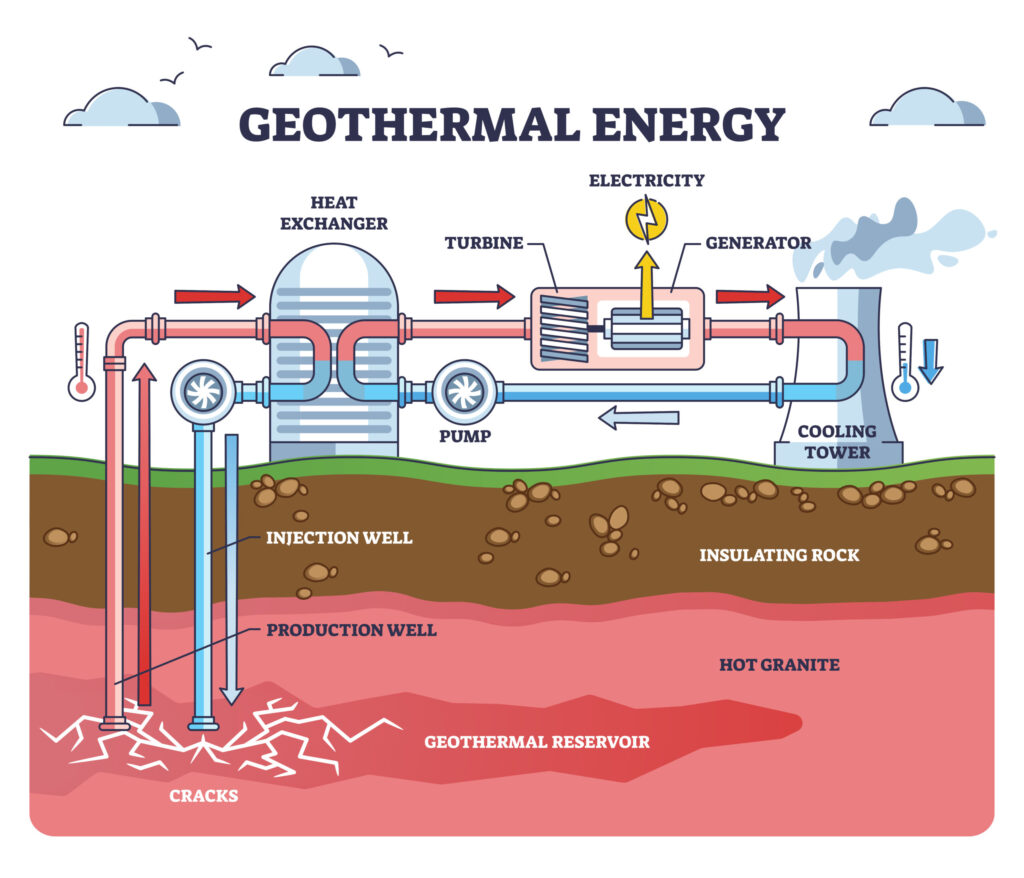
Electricity from solar PVs may be abundant during the day, yet fossil-fuel plants still provide balancing power after sunset and during winter demand peaks. To correct this temporal mismatch, international power-procurement standards are moving toward 24/7 carbon-free energy (CFE): matching demand with carbon-free generation on an hourly basis within the same transmission system. Pairing solar and wind with lithium-ion battery energy storage systems (BESS) capable of several hours of discharge can effectively moderate the early-evening peak. Covering multiday periods of low wind or poor weather—and supply shortfalls deep into the night—may nevertheless require generation capacity three to five times greater than load, together with long-duration storage. The result is higher system-wide costs and marginal prices. Against this backdrop, next-generation geothermal power—largely weather-independent and capable of capacity factors above 90%—is gaining prominence in hyperscalers’ procurement strategies.
The business model described in Fervo Energy’s Form S-1 registration statement illustrates how next-generation geothermal is moving beyond R&D and demonstration into an infrastructure asset class supported by commercial-scale offtake. At Cape Station in Utah, Fervo has signed a 396 MW power purchase agreement with Google. The arrangement also includes offtake options for approximately 600 MW of additional capacity by 2030, creating a pathway to roughly 1 GW in total. It is emerging as a new commercial model that directly links the electricity demand of digital infrastructure with investment in clean energy.
Contents
Commercial Design of the Clean Transition Tariff (CTT) and the Regulatory Rationale for Cost Protection
Under conventional rate structures, the early-stage premium and development risks associated with new technologies may be passed through to a broad customer base, including households and small and medium-sized businesses. In Japan, criticism remains persistent that renewable-energy surcharges are placing pressure on household budgets. Concerns over the equitable allocation of such costs have become a structural obstacle to regulatory approval for large-scale renewable-energy development.
The institutional response is the Clean Transition Tariff (CTT), developed in Nevada by Fervo Energy, Google, and NV Energy and subsequently extended to PacifiCorp’s service territory in Utah. Its defining feature is that Google, as a large voluntary offtaker, bears the capital, operating and maintenance, interconnection, and technology-risk costs associated with deploying next-generation generation resources. The utility procures electricity from a designated generator, such as Fervo Energy, and supplies it to the offtaker, such as Google. Because the offtaker purchases the volume specified under the CTT at the agreed price, the incremental cost does not flow through to other customers’ rates. This structure also gives regulators a more defensible basis for approval.
Although the offtaker pays a premium, it receives not only energy value (kWh) but also resource adequacy—the capacity value supported by geothermal’s capacity factor of more than 90% for instance. This enables data centers to limit their exposure to peak-period grid charges and spot-market price spikes, improving the predictability of electricity costs.
Why Take-or-Pay and Deemed Generation Payments Matter
Geothermal power plant has no fuel cost, but well drilling requires substantial, long-dated upfront investment, leaving most lifetime generation costs fixed. For developers, offtake agreements should therefore generally adopt a full-volume take-or-pay obligation. Even if a data center’s IT load temporarily declines because of maintenance or fluctuations in demand, the offtaker continues to pay for the agreed baseload capacity. A second critical mechanism is the deemed generation payment. If congestion or a transmission or distribution operator’s instructions result in curtailment, the offtaker compensates the project for the energy revenue, capacity value, and renewable energy certificates that would have been realized under normal operations. This partially insulates the generation special-purpose vehicle’s revenue from grid constraints. If the generator must bear the full cost of an offtaker-driven suspension of deliveries and/or third-party risks arising from the grid, revenue predictability deteriorates. Without dependable capital inflows, advances in subsurface technology will not translate into power plants.
Availability Guarantees and a Subsurface Cure Period
In exchange for take-or-pay commitments and deemed generation protection, an offtaker may require the generator to guarantee a minimum annual equivalent availability of 85% to 90% or more, with predetermined liquidated damages for underperformance. Yet subsurface conditions can never be known with complete certainty. Even if geothermal-fluid pressure or temperature declines, immediate termination or event of default would be impractical. A more balanced structure would build a defined cure period into both the power purchase agreement and the financing documents. If the operator identifies the cause, implements the recovery plan, and restores output to the contractual threshold within that period, the contracts remain in force. Such a cure period is a crucial contractual mechanism for reconciling subsurface uncertainty with the revenue stability required by project finance.
The Core of Price Formation: From Plant-Level LCOE to the Optimal Total System Cost of Procurement
Across North American markets including CAISO, WECC, and PJM, contracted prices for next-generation geothermal PPAs have generally ranged from $70 to $90/MWh. On a nominal price basis, that is more expensive than utility-scale solar or onshore wind at roughly $30 to $45/MWh. Hyperscalers, however, do not evaluate a resource solely on its stand-alone levelized cost of electricity. The relevant metric is the total cost of procuring clean, firm power capable of delivering hourly decarbonization. Viewed through that lens, geothermal’s high capacity factor and stable output reduce the additional costs associated with storage, generation overbuild, and grid reinforcement.
Achieving hourly matching above 95% with only solar, wind, and short-duration batteries would require a substantial overbuild of generation capacity to cover hours of weak irradiance or wind. Transmission lines and substations would also need reinforcement to accommodate variable output, eroding system-wide economics. Curtailment would rise during periods of peak generation, further increasing the effective cost of procurement.
By contrast, incorporating geothermal with a capacity factor above 90% as a portfolio’s foundational resource can reduce both storage requirements and generation overbuild. Geothermal also makes intensive use of interconnection capacity throughout the year. In markets where securing a position in the interconnection queue takes years—or even more than a decade—it can also lower grid-upgrade costs per unit of output. Google’s option to secure approximately 600 MW of additional capacity at Cape Station can be understood as a strategic move to lock in access to stable 24/7 supply ahead of future grid-capacity constraints.
Strategic Implications for Japan and the Asia-Pacific Region
Japan possesses some of the world’s largest geothermal resources, yet geothermal accounts for only about 0.3% of its power mix. The Ministry of Economy, Trade and Industry’s Geothermal Development Acceleration Package and the roadmap of the Public-Private Council for Next-Generation Geothermal Development point toward raising geothermal’s share to 1%–2% by 2040 and multiplying installed capacity several times over. A model overly dependent on the conventional feed-in tariff and feed-in premium (FIT/FIP) regime, however, raises questions about the long-term sustainability of both fiscal support and customer-funded charges.
Hyperscale data-center development by both foreign and domestic technology companies continues in Japan, particularly in Inzai, Chiba Prefecture, and the Kansai region. As a result, limited grid capacity and access to 24/7 CFE are becoming critical constraints on site selection and operations. The lessons that Japanese utilities, energy companies, and policymakers should draw from the CTT model can be distilled into two priorities.
First, Japan should design its own clean transition tariff—potentially a bilateral rate structure using designated wholesale supply—to connect power-intensive industries with geothermal developers without relying on the existing FIT/FIP framework. Unlike FIT/FIP, which spreads incremental costs across the general customer base, and unlike a physical PPA based on a direct bilateral contract between generator and offtaker, this model would place the utility in an intermediary role and support delivery of 24/7 CFE. A framework under which data-center operators and other users of decarbonized baseload power bear development costs and capacity premiums could channel private capital into domestic demonstrations of next-generation geothermal technology.
Second, Japan should plan geothermal development in tandem with emerging power-intensive industries, including data centers and next-generation semiconductor clusters. If demand from data centers and semiconductor fabs can serve as the anchor for next-generation geothermal projects supported by long-term take-or-pay contracts, the credit quality of the offtake can materially improve project-finance bankability. The decisive question is whether power-intensive industries, geothermal technology providers, generators, investors, utilities, regulators, and financial institutions can establish a common commercial and institutional platform. That is the key to launching a next-generation geothermal power industry capable of realizing its considerable potential.
References
- GHG Protocol, “Upcoming Scope 2 Public Consultation: Overview of Revisions,” September 29, 2025.
- GHG Protocol, “Upcoming Scope 2 Public Consultation: Hourly Matching and Deliverability,” October 14, 2025.
- Google, “24/7 by 2030: Realizing a Carbon-free Future,” September 2020.
- Google, “24/7 Carbon-Free Energy: Methodologies and Metrics,” February 2021.
- Google, “Google’s new model for clean energy approved in Nevada,” May 13, 2025.
- Fervo Energy, “Fervo Energy and Google Sign 396 MW PPA,” September 1, 2026.
- Agency for Natural Resources and Energy, “Study Group on the Promotion of Geothermal Power Generation (Geothermal Development Acceleration Package),” last updated September 25, 2025.
- Agency for Natural Resources and Energy, “Public-Private Council for the Promotion of Next-Generation Geothermal Development,” last updated July 28, 2026.
- Ministry of the Environment, Green Value Chain Platform Office, “What You Need to Know: The Latest Developments in the Revision of the GHG Protocol,” November 25, 2025.


Free Membership Registration
What You Can Do After Registering
All articles are available to read free of charge. Free membership registration is required to download reports.
- You can download all reports that we make available free of charge in the future.
- You can opt in to receive our newsletter (the launch date and frequency will be determined at a later date).

This is a Japanese-English bilingual media outlet specializing in geothermal energy, operated by GeoVanguard Energy Inc. Information from Japan tends to stay within Japanese, while overseas information does not reach Japan. Our purpose is to bridge that gap.