Policy and Regulation
The Evolution and Reappraisal of Geothermal Development in Japan
SHARE


—Structural Barriers Constraining the World’s Third-Largest Resource Potential, and a Next-Generation Outlook for Energy Security and Industrial Development—
Japan’s electricity supply remains heavily dependent on thermal power. According to the Agency for Natural Resources and Energy’s final figures for fiscal 2024, total electricity generation reached 991.1 TWh, of which thermal power excluding biomass accounted for 67.5%, renewable energy including hydropower 23.1%, and nuclear power 9.4%. Although the heightened dependence on fossil fuels that followed the Great East Japan Earthquake is gradually easing, the supply structure remains highly exposed to fuel prices, exchange rates, and international developments. Meanwhile, domestic electricity demand—long in decline—may begin to rise as new and expanded data centers supporting generative AI and leading-edge semiconductor plants come online, and as industry, transport, and heat demand become increasingly electrified. Advancing decarbonization without compromising security of supply will require not only large-scale deployment of solar and wind power, but also stronger grids, battery storage, balancing capacity, and an expanded portfolio of low-carbon generation that can operate independently of weather conditions.
It is in this context that geothermal power is being reassessed. Located along the Pacific Ring of Fire, Japan possesses an estimated 23.47 GW of conventional geothermal resources under commonly used assumptions—the third-largest potential in the world. Yet installed capacity stood at only about 0.6 GW at the end of fiscal 2024, and geothermal supplied merely 0.3% of total electricity generation. This wide gap between resource potential and actual deployment reflects the cumulative effect of several barriers: subsurface resource risk, restrictions in natural parks, the need to build consensus with hot-spring communities, and lengthy development timelines. This article first reviews Japan’s overall power mix and renewable-energy policy and clarifies the role geothermal can play within them. It then examines how Japan moved from geothermal pioneer to prolonged stagnation, the structural factors that have impeded development, and the current state of policy support and next-generation technologies. Finally, it considers the conditions required to expand geothermal as a stable, domestically sourced power supply.
Contents
Japan’s Power Mix and Renewable-Energy Policy: The Context for Geothermal
From Nearly 70% Thermal Power to a Low-Carbon Generation Mix Japan generated 991.1 TWh of electricity in fiscal 2024. Thermal power excluding biomass accounted for 67.5%, renewables including hydropower for 23.1%, and nuclear power for 9.4%. Compared with the previous year, the renewable share rose by 0.2 percentage points and nuclear by 0.9 points, while thermal power declined by 1.1 points. Solar photovoltaics have led renewable deployment, but further diversification across hydropower, biomass, wind, and geothermal remains essential. The Seventh Strategic Energy Plan projects a fiscal 2040 mix of roughly 40–50% renewables, 20% nuclear, and 30–40% thermal power. These are not point forecasts but ranges reflecting uncertainty; they assume progress in demand-side efficiency, nuclear restarts, renewable investment, and the decarbonization of thermal generation.
Distinct Roles and Constraints by Energy Source Solar power has driven renewable growth through rapid deployment, falling costs, and short construction schedules, but must address daytime output concentration, seasonal variability, and siting constraints. Wind—especially offshore wind—offers substantial scale, yet requires long-term industrial infrastructure spanning ports, vessels, seabed engineering, transmission networks, and domestic supply chains; project withdrawals also underscore continuing concerns over economics. Hydropower is a stable, long-lived source, but few large new sites remain, shifting emphasis to refurbishment and small and medium-sized projects. Biomass can provide dispatchable power, but fuel sustainability, import dependence, and logistics costs demand close scrutiny. Nuclear power is expected to contribute as a low-carbon source, subject to safety, restarts, decommissioning, and spent-fuel management. Thermal generation will remain necessary in the near term for adequacy and flexibility even as its share declines, making reduced output from inefficient coal plants, secure LNG procurement, and decarbonization through hydrogen, ammonia, and CCUS key priorities.
From Capacity Expansion to Market Integration and Regional Coexistence Introduced in fiscal 2012, Japan’s feed-in tariff (FIT) improved revenue visibility and helped establish the early renewable-energy market. The renewable share rose from 10.4% in fiscal 2011 to 23.1% in fiscal 2024, but challenges also emerged: the public burden of renewable surcharges, dwindling suitable sites, dormant projects, disaster risk, landscape impacts, and local consent. Since fiscal 2022, the feed-in premium (FIP) has added a premium to market-linked electricity sales, encouraging market integration through generation forecasting and battery use. Competitive auctions, expiry of inactive approvals, and mandatory community briefings have likewise become central to containing costs and strengthening project discipline.
Three Implementation Conditions That Will Determine Policy Success First, deployment costs and the public burden must be contained. Mature technologies should move toward auctions and market integration, while early-stage technologies require focused support for R&D, demonstration, and mass-production investment. Second, networks must connect generation sites with demand centers. Because attractive renewable resources are concentrated in regions such as Hokkaido, Tohoku, and Kyushu, anticipatory investment in interregional links and backbone grids, together with grid operation that expands hosting capacity, is indispensable. Third, projects must deliver regional benefits and uphold long-term discipline. Beyond safety, disaster resilience, scenery, and environmental protection, plans should incorporate tax revenue, employment, heat use, and local investment, while clearly assigning responsibility for decommissioning and refurbishment. These conditions apply equally to geothermal, but subsurface uncertainty and long lead times make early information sharing among government, industry, and communities especially important.
Grids, Storage, and Next-Generation Technologies for Large-Scale Deployment Raising renewables to 40–50% will require more than adding generation capacity. Japan must develop interregional links and backbone grids, modernize connection rules, and integrate supply-demand forecasting, utility-scale and behind-the-meter batteries, demand response, and balancing markets. Support must also reflect the siting, cost, and supply-chain challenges specific to rooftop solar, perovskite photovoltaics, offshore wind, hydropower refurbishment, sustainable biomass, and other technologies. Policy is therefore shifting from simply “adding renewables” to operating them reliably and at low cost within the power system while maintaining constructive relations with host communities.
Geothermal as Firm Power Supporting Variable Renewables Although geothermal currently supplies only a small share of Japan’s electricity, its high capacity factor and limited exposure to diurnal and weather-driven fluctuations give it a value distinct from solar and wind. It cannot meet Japan’s power demand on its own, but securing a meaningful volume of this domestic, low-carbon resource would help stabilize a renewables-led generation mix while reducing dependence on imported fuels. The Seventh Strategic Energy Plan’s fiscal 2040 target of roughly 1–2% geothermal therefore reflects not only the need for quantitative expansion, but also geothermal’s qualitative value to the power system.
From Pioneer to Stagnation: Half a Century of Geothermal Development in Japan
Japan made an exceptionally early start in geothermal development by global standards.
- From the Pioneering Years to the Sunshine Project (1960s–1980s): In 1966, Japan Metals & Chemicals commissioned the Matsukawa Geothermal Power Plant in Iwate Prefecture. Japan’s first commercial geothermal plant began at 9.5 MW, was expanded in stages, and reached 23.5 MW in 1993. Following the two oil shocks of the 1970s, the government launched the national Sunshine Project in 1974. Led by NEDO, large-scale exploration and development targeted hydrothermal convection systems, giving rise to flash-steam plants—including Hachimantai, Onuma, Onikobe, Hatchobaru, Mori, and Yanaizu-Nishiyama—that became the backbone of Japan’s geothermal fleet.
- Development Stagnation (late 1990s–early 2010s): As electricity-market liberalization gained momentum in the late 1990s and inexpensive fossil fuels such as LNG and coal became more competitive, conditions changed sharply. The risk of unsuccessful exploration drilling and lead times exceeding ten years were considered excessive under a purely private, stand-alone commercial model. Hatchobaru Unit 2 began operating in 1990, followed in 1996 by Kakkonda Unit 2, Ogiri, Takigami, and others; however, reduced large-scale government support contributed to a prolonged lull in new major projects. More recently, comparatively large plants such as Wasabizawa in 2019 and Appi in 2024 have entered service.
- FIT Introduction and a Localized Revival (from 2012): The 2012 FIT, offering a generous ¥40/kWh tariff for projects below 15 MW, revived development—particularly small binary plants using existing hot-spring wells. Yet these projects remained small and distributed, and did not fundamentally resolve the stagnation of utility-scale development needed to support Japan’s backbone grid.
Japan’s geothermal sector thus stagnated not because of insufficient technical potential, but because it failed to establish three conditions simultaneously: institutions capable of absorbing subsurface resource risk, access to developable areas, and trust with local communities. The next section examines how these three barriers have interacted to lengthen development schedules and increase project risk.
Three Structural Barriers to Development: Resource Risk, Siting Restrictions, and Local Consent
Despite possessing world-class potential, Japan has seen utility-scale geothermal development constrained for decades by three structural barriers distinctive to the country.
[Three Structural Factors Constraining Geothermal Development in Japan]
1) Weak Project Economics Driven by Exploration and Drilling Costs and Insufficient Support
Even after surface surveys and geophysical exploration, commercially attractive steam or hot water can be confirmed only by drilling. Developers therefore bear substantial early-stage exploration risk: major expenditures may still fail to produce an adequate resource. Japan also has relatively few geothermal drilling campaigns, limiting continuous utilization of rigs, specialist personnel, and equipment and keeping drilling costs high compared with more active overseas markets. More than ten years may elapse between initial surveys and commercial operation, requiring capital to be committed long before revenue begins. Yet policy support for early surveys and drilling, and electricity-price support for long-term cost recovery, remain insufficient to absorb these risks and costs fully. Consequently, even high-potential sites may offer weak overall economics after financing costs, making investment in new projects difficult.
2) Promising Resources within Natural Parks and Associated Siting Constraints
Materials published by the Japan Geothermal Association and others estimate that roughly 80% of Japan’s promising geothermal resources lie within designated national or quasi-national parks overlapping volcanic zones. In Special Protection Zones and Class I Special Zones under the Natural Parks Act, structures and surface alteration have long been tightly restricted to protect landscapes and ecosystems. Although technical approaches such as directional drilling from outside park boundaries have been explored, permitting procedures and site-specific administrative practices have contributed to longer development timelines.
3) Building Trust with Local Communities
Drilling a geothermal well requires authorization from the prefectural governor under the Hot Springs Act. In many prefectures, decisions follow review by a hot-spring council or similar body, but council names, meeting frequency, and application and review practices vary by municipality. Where meetings are held only a few times a year or sequential applications are required for each well, procedures can lengthen development schedules. More important than the formal system, however, is consensus-building with local communities, including hot-spring districts. Hot springs are not merely groundwater resources; they are also longstanding cultural assets and pillars of local tourism economies. Concerns over declining flow rates or temperatures are therefore difficult to dispel through scientific monitoring or hydrogeological explanations alone. Developers must share information from the earliest survey stages and work with communities to design monitoring methods, emergency responses, and mechanisms for sharing project benefits.
Conditions for a Restart: Policy Support and the State of Next-Generation Technologies
After decades of stagnation, Japan’s geothermal policy has now clearly shifted toward a “fundamental acceleration” of development.
1) Policy Target of 1–2% by 2040
The Seventh Strategic Energy Plan positions geothermal as a stable source complementing variable renewables such as solar and wind. It assigns geothermal roughly 1–2% of the 2040 power mix, implying substantial growth from today’s approximately 0.3%. However, the corresponding capacity requirement and development pace depend on assumptions including capacity factors and total future electricity generation. Achieving this level will therefore require both steady commercialization of existing projects and parallel progress in exploration, permitting, local consent, and drilling capacity at new sites.
2) Streamlined Permitting and Public–Private Sharing of Exploration Risk
Measures advanced by the Ministry of Economy, Trade and Industry and the Ministry of the Environment combine several mechanisms to shorten geothermal lead times that can exceed ten years. Key elements include smoother permitting based on successful projects in natural parks, greater use of directional drilling from outside park boundaries, more efficient EIA, and reduced early-stage exploration risk through JOGMEC equity participation and debt guarantees. The extent to which these measures shorten actual schedules will depend on site-specific natural conditions, survey results, local consent, and administrative implementation.
3) A National Program to Bring Next-Generation Geothermal to Market
To move beyond the limitations of development dependent on conventional hydrothermal systems, METI established the Public–Private Council for Next-Generation Geothermal. In addition, NEDO’s Green Innovation Fund project for the Development of Next-Generation Geothermal Power Technologies is promoting the deployment of the following innovations as a national initiative under a funding framework capped at ¥110.2 billion.
- Supercritical Geothermal Power: Technology development aimed at substantially higher output by utilizing fluids expected to exist in a supercritical state at depths of roughly 3–6 km and temperatures of about 400–600°C. The existence and properties of the resource, drilling methods, corrosion-resistant materials, and long-term operational stability all require validation; current output estimates should therefore be treated as technical expectations rather than demonstrated commercial performance.
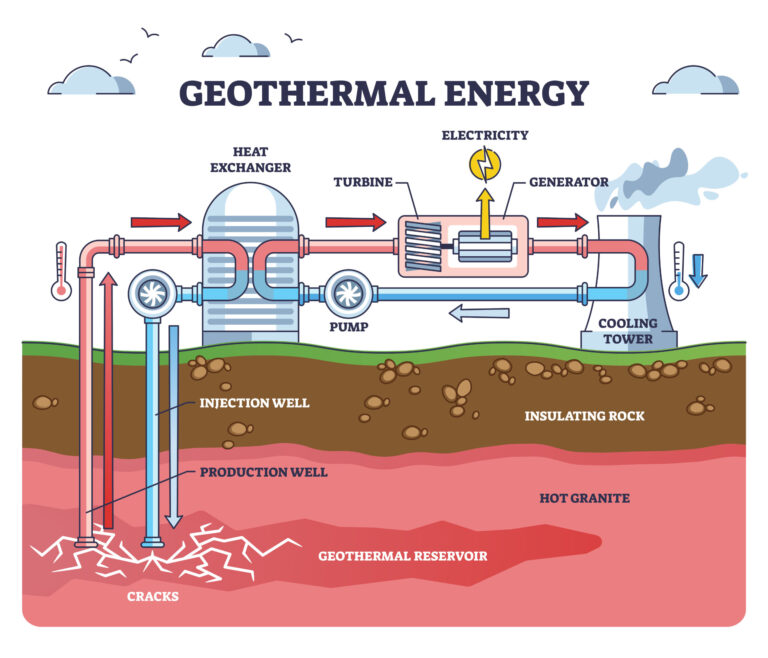
- Enhanced Geothermal Systems (EGS) and Advanced/Closed-Loop Geothermal Systems (AGS): EGS creates engineered reservoirs or flow paths in hot rock and circulates fluid between injection and production wells to recover heat. Closed-loop systems instead circulate a heat-transfer fluid through sealed underground piping, absorbing heat from the surrounding rock. Both could reduce dependence on the naturally occurring hydrothermal reservoirs required by conventional geothermal, although their interaction with subsurface fluids and their hydrological effects differ. They are expected to help limit interference with hot-spring zones, but commercialization will require further validation of drilling costs, heat-recovery efficiency, and long-term operating performance.
The Strategic Value of Expanding Geothermal: Security of Supply and Industrial Capability
Expanding geothermal would do more than raise the renewable share. It also addresses two policy imperatives: securing a stable power source independent of imported fuels, and sustaining a domestic industrial base spanning drilling, materials, power-generation equipment, and subsurface assessment.
- Reducing Dependence on Imported Fossil Fuels (Energy Security): Japan imports most of its fossil fuels, leaving fuel costs and electricity prices exposed to geopolitical tensions and yen depreciation. Geothermal generation requires no imported fuel during operation and can continuously utilize domestic subsurface heat. Securing a meaningful geothermal fleet would therefore reduce the vulnerability of electricity supply to fuel-price and exchange-rate volatility while increasing the share of energy produced within Japan’s regions.
- Strengthening the Competitiveness of Geothermal Industries (Industrial Development): Mitsubishi Heavy Industries, Toshiba Energy Systems & Solutions, and Fuji Electric together hold a substantial cumulative share of the global geothermal steam-turbine market. Nippon Steel, JFE Steel, and other Japanese manufacturers have also accumulated expertise in specialized casing steel for ultra-high-temperature and highly corrosive environments. Revitalizing the domestic market would create demonstration opportunities across the supply chain—from heavy machinery, materials, drilling, and reservoir assessment to operations and maintenance—and could provide a platform for exporting next-generation geothermal technologies. However, translating more domestic projects into export competitiveness will require lower costs, long-term operating data, and sufficient personnel and drilling equipment.
Geothermal is one of the few large-scale domestic energy resources available to Japan. Its potential, however, will not be realized automatically through deregulation or technological innovation alone. Japan must put in place an integrated framework that shares subsurface resource risk between the public and private sectors, establishes development rules compatible with environmental protection, and enables hot-spring communities to participate from the planning stage. The pace of future deployment will also depend on whether next-generation technologies—including EGS, closed-loop systems, and supercritical geothermal—can progress from demonstration to commercialization. Positioning geothermal simultaneously within energy-security and industrial policy, and building a durable development platform around it, will be the key to transforming Japan’s “sleeping resource” into a practical source of power.
References
- Agency for Natural Resources and Energy, “Final Report on Energy Supply and Demand Results for FY2024,” April 14, 2026 (accessed October 5, 2026).
- Agency for Natural Resources and Energy, “Strategic Energy Plan (Seventh Strategic Energy Plan and Outlook for Energy Supply and Demand in FY2040),” February 2025 (accessed October 5, 2026).
- Agency for Natural Resources and Energy, “Guidebook to Japan’s Renewable Energy FIT and FIP Schemes, FY2026 Edition,” 2026 (accessed October 5, 2026).
- Agency for Natural Resources and Energy, “Toward the Advancement of Next-Generation Geothermal Energy,” materials for the Public–Private Council for Next-Generation Geothermal, April 14, 2025 (accessed October 5, 2026).
- Japan Organization for Metals and Energy Security (JOGMEC), “Maximizing the Use of Japan’s World-Class Geothermal Potential: The Carbon-Recycling CO2 Geothermal Power Generation Technology Project,” February 28, 2022 (accessed October 5, 2026).
- Japan Organization for Metals and Energy Security (JOGMEC), “Global Trends in Geothermal Development,” January 27, 2025 (accessed October 5, 2026).
- Ministry of the Environment, “Treatment of Geothermal Development within National and Quasi-National Parks,” Environment and Nature Conservation Bureau Notification No. 2109301, September 30, 2021 (accessed October 5, 2026).
- New Energy and Industrial Technology Development Organization (NEDO), “Development of Next-Generation Geothermal Technologies,” Green Innovation Fund Project (accessed October 5, 2026).

Free Membership Registration
What You Can Do After Registering
All articles are available to read free of charge. Free membership registration is required to download reports.
- You can download all reports that we make available free of charge in the future.
- You can opt in to receive our newsletter (the launch date and frequency will be determined at a later date).

This is a Japanese-English bilingual media outlet specializing in geothermal energy, operated by GeoVanguard Energy Inc. Information from Japan tends to stay within Japanese, while overseas information does not reach Japan. Our purpose is to bridge that gap.